The Button Labeled 'Snacks' Does Nothing: A Field Investigation Into Appliance Settings That Were Never Meant to Be Pressed
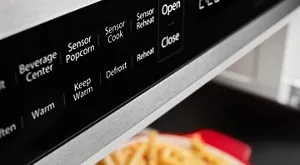
Photo: confusing microwave control panel buttons close up kitchen appliance, via kitchenaid-h.assetsadobe.com
Every American kitchen contains at least one button that nobody has ever pressed on purpose. Not because it's broken. Because it's wrong. It promises something no appliance should promise — 'Proof,' 'Reheat Pizza,' a setting depicted only as a cartoon shrimp wearing what appears to be a tiny hat — and we all silently agree to leave it alone, like a wasp nest made of plastic.
This week, we asked Didapo readers to photograph their most inexplicable appliance settings. We received 214 submissions. Several contained what experts would describe as 'concerning amounts of duct tape.' All of them raised the same question: who is designing these buttons, and are they okay?
The Preset tier list, ranked by emotional damage
We scored each submission on a scale of 1 to 10, where 1 is 'harmless' and 10 is 'this appliance knows something I don't.'
Tier S — 'Reheat Pizza' (multiple readers). Every microwave in America has this button. Not one pizza in American history has been improved by it. It is the only setting that exists purely as a lie, a monument to optimism, a tiny monument to every 2 a.m. decision we've ever regretted.
Tier A — 'Beverage.' What does it do? Heats liquid. To what temperature? Unclear. For how long? The manual says 'until beverage.' Thanks.
Tier B — the potato with radiating lines. This is allegedly a symbol for 'baked potato.' It looks like a potato that has seen things. Readers report pressing it and receiving either a perfect potato or a smoking geological specimen, with no discernible pattern. We believe the outcome is decided by the potato.
Tier F — 'Soften/Melt.' On a microwave. A function for butter that requires you to already understand butter at an engineering level. One reader in Ohio wrote in: 'It has two settings, Soften 1 and Soften 2, and the difference between them is a matter of faith.'
The error messages that read like threats
Appliances don't just have confusing buttons. They have error messages that feel less like diagnostics and more like warnings from a lighthouse keeper who's given up.
Our reader-submitted ranking of the most ominous:
- "E-24: Door." Door what? Door where? The message offers no verb. The door is fine. The door has always been fine. Is it?
- "Err3 — Call service." The number three implies an Err1 and Err2 exist, but no one has ever seen them, like photos of a secretive royal family.
- "HOT." Displayed on a toaster oven, unprompted, at 4 a.m., to a reader who swears it wasn't plugged in. We are not saying this is a ghost. We are not saying it isn't.
- "F7." Just F7. A stove in Florida has displayed F7 for six years. The family has made peace with it. F7 is family now.
We read the manuals. The manuals read us back.
In the interest of journalism, we located user manuals for six of the submitted appliances. This was harder than expected, because modern manuals have evolved to survive without being read. They arrive as a single folded sheet in seventeen languages, 16 of which say something like 'do not immerse' while the English portion offers the phrase 'operate in accordance with normal intended usage scenarios.'
The manual for one reader's air fryer contains a troubleshooting section with exactly one entry: 'If the unit does not work, the unit may not work.' We contacted the manufacturer for clarification. They sent a PDF. The PDF was the same manual. We are trapped in a loop and honestly it's the most coherent customer service experience we've had this year.
The gallery of shame
Highlights from reader submissions, reproduced with permission and mild concern:
- A rice cooker with a setting labeled 'Cake' that one reader used once and describes as 'the reason I don't host holidays anymore.'
- A dishwasher with a 'Hi Temp Scrub' cycle, which sounds less like dishwashing and more like an off-brand wrestling pay-per-view.
- A blender whose highest setting is depicted as a tornado inside a cup, which is legally a confession.
- An air fryer with a 'Dehydrate' button that a reader in Tucson pressed 'to see what happens,' and what happened was 'nothing, for eight hours, and then a smell.'
So why do these buttons exist?
We asked an actual engineer, who explained that appliance presets are often decided by marketing departments testing what words perform well in focus groups, then handed to firmware teams who implement them as fixed time-and-power combos. In other words: 'Reheat Pizza' was never about pizza. It was about the idea of pizza, which is also what America runs on, spiritually.
So the next time you stand in your kitchen at midnight, staring at a button that says 'Snacks' and doing nothing — know that you're not confused. The button is confused. It was born in a boardroom, tested on nobody, and shipped to your countertop to keep its secrets.
Press it anyway. What's the worst that could happen?
(Do not press it. One reader pressed it. We cannot discuss what happened to the reader.)